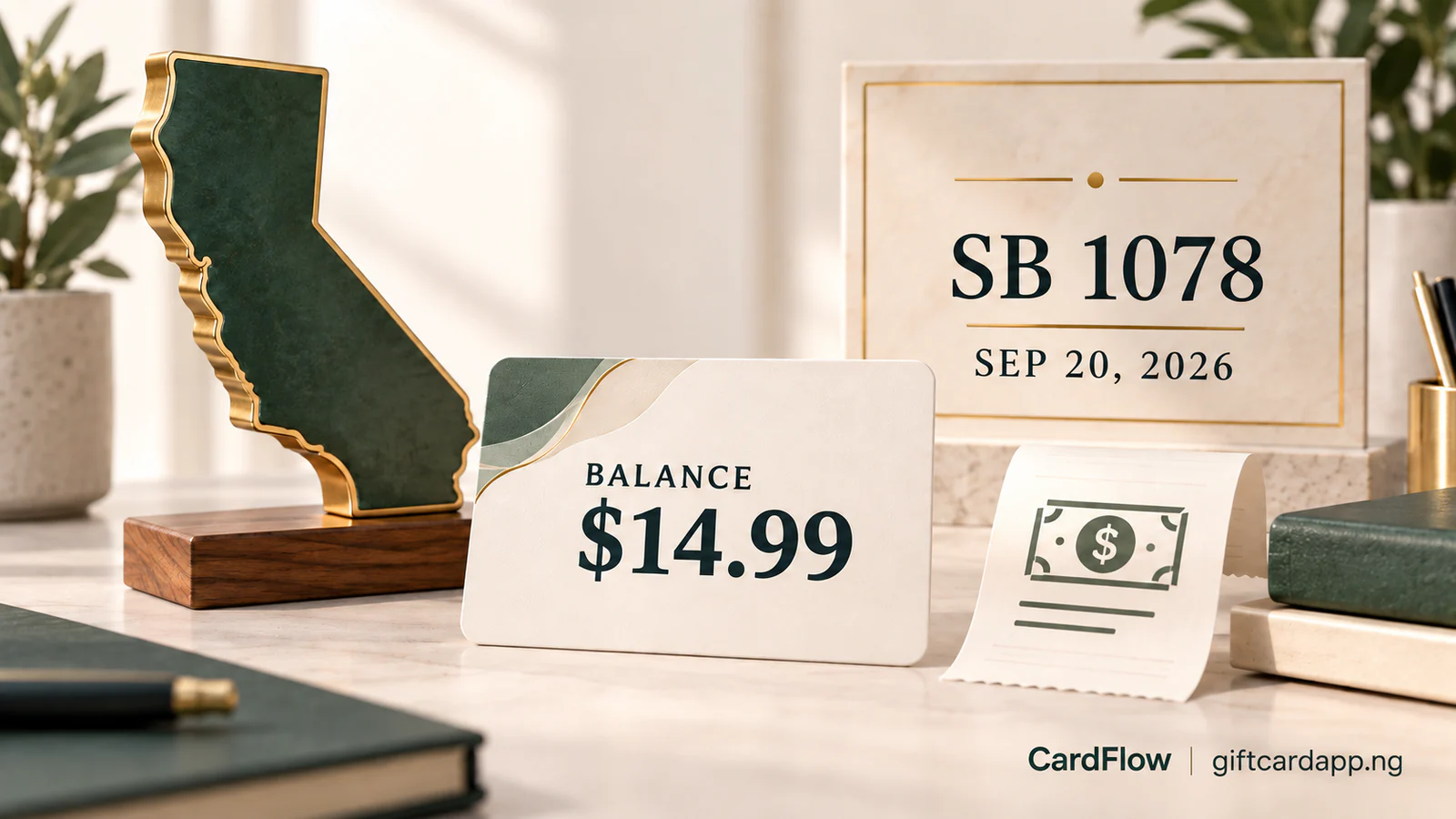
News update, fact-checked October 2, 2026: California Governor Gavin Newsom approved Senate Bill 1078 on September 20. The new law gives qualifying businesses a temporary way to sell certain gift certificates printed before the state’s cash-redemption threshold changed. It does not reduce the current right to redeem a qualifying balance of less than $15 for cash.
What California signed on September 20
The chaptered text of SB 1078 says Governor Newsom approved the bill and it was filed with California’s Secretary of State on September 20, 2026. The measure becomes effective January 1, 2027.
Its purpose is narrow. Some businesses had a supply of physical gift cards printed before California raised its small-balance cash-redemption threshold. Those cards can carry outdated language. SB 1078 lets an issuer sell qualifying old stock through December 31, 2028, but only when all of the statute’s conditions are met.
The official release from Senator John Laird explains the practical trigger: the Santa Cruz Beach Boardwalk had about one million cards printed with the old wording, representing roughly $250,000 of inventory and an estimated two-year supply. The transition avoids discarding that stock while preserving the current consumer protection.
The rule before and after SB 1078
| Question | Current California rule | What SB 1078 changes |
|---|---|---|
| Cash-out threshold | A qualifying gift certificate with a cash value of less than $15 is redeemable in cash | No change to the threshold |
| Exactly $15 | Not inside the statutory “less than $15” rule | No change |
| Electronic gift cards | Included in California’s definition under SB 22, subject to scope and exceptions | No new expansion |
| Older physical stock | May carry the pre-April wording | Qualifying pre-April 1, 2026 stock may be sold through December 31, 2028 |
| Customer notice | The operative law controls, not an outdated number printed on old stock | A 24-point notice is required at each relevant point-of-sale device |
| Issuer records | Ordinary compliance rules apply | The issuer must retain records reasonably showing the manufacture or print date |
The earlier chaptered text of SB 22 raised the mandatory small-balance threshold from less than $10 to less than $15 and made the new provision operative on April 1, 2026. It also expressly included electronic gift cards in the California definition.
The distinction between “less than” and “up to” matters. A $14.99 balance is less than $15. A $15.00 balance is not. A merchant may voluntarily provide a refund at a higher amount, but SB 22’s automatic small-balance rule should not be rewritten as “$15 or less.”
Three conditions for using the old printed stock
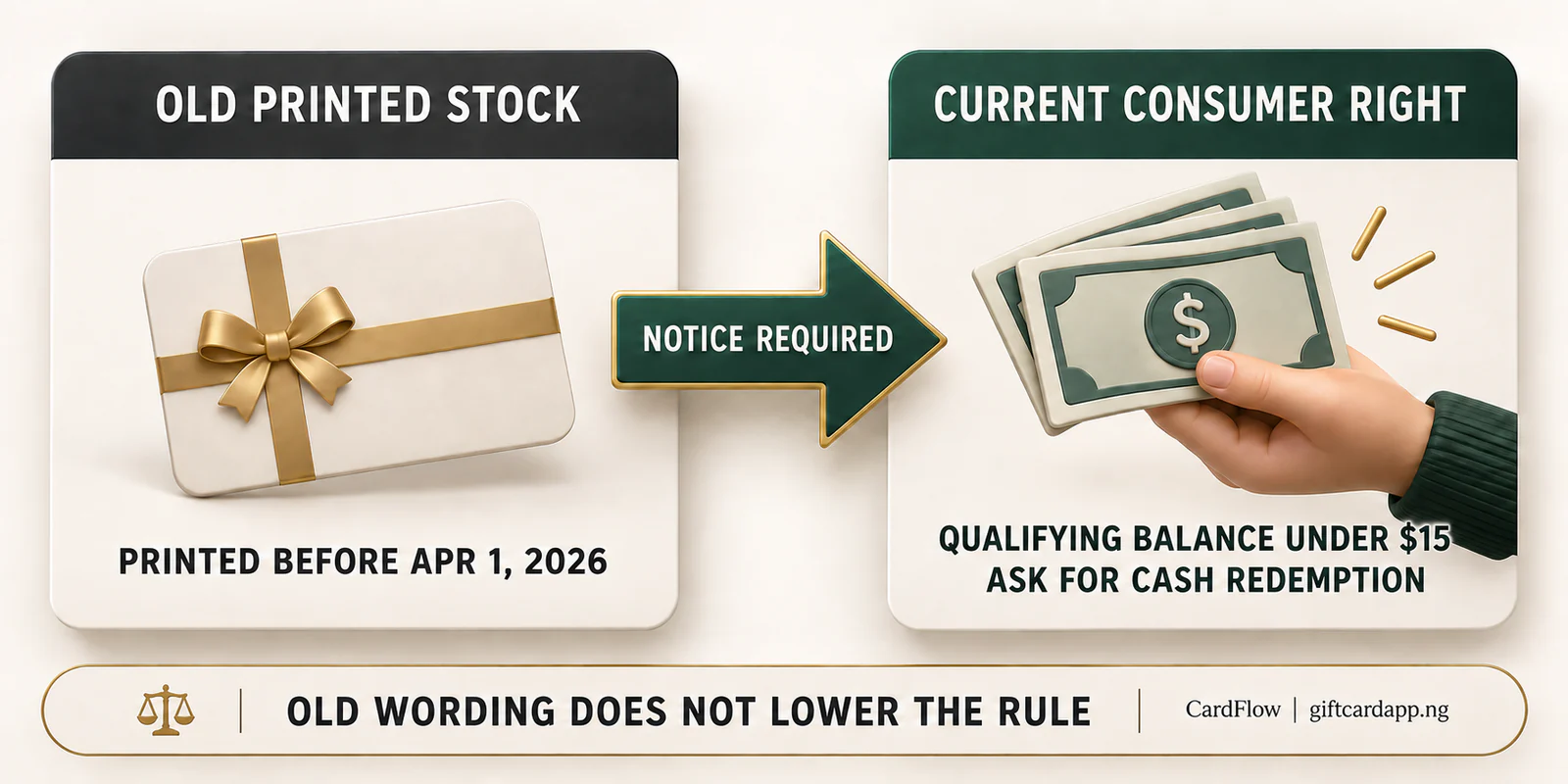
SB 1078 does not give every issuer a general exemption. The transition applies only when the issuer satisfies all three conditions in the new Civil Code section:
- The card predates the threshold change. The gift certificate must have been manufactured or printed before April 1, 2026.
- The current right is displayed clearly. At each point-of-sale device where the card may be purchased, loaded or redeemed for cash, the issuer must display a notice in at least 24-point type stating that a gift certificate with a cash value of less than $15 is redeemable in cash for its cash value.
- The print date can be supported. The issuer must maintain records in the ordinary course of business that reasonably demonstrate when the card was made or printed.
If those conditions are met, the issuer is protected from civil or criminal penalties solely because the card itself shows a cash-redemption threshold lower than the current amount. That last phrase is important: the law does not excuse unrelated non-compliance.
Which gift cards should not be assumed to qualify
California’s statutory definition is broader than a paper voucher, but it is not unlimited. SB 22 says “gift certificate” includes gift cards and electronic gift cards. It also excludes certain cards usable with multiple unaffiliated sellers when any expiration date is printed on the card. That means a consumer should not automatically apply the California rule to every Visa, Mastercard or other network-branded prepaid product.
Other exceptions matter too. The under-$15 redemption provision does not apply to a gift certificate donated to a nonprofit or charitable organisation without consideration when the statutory disclaimer is present. Specified promotional, fundraising and perishable-food certificates can also be treated differently under the wider section.
The safest approach is to identify the exact product first:
- Is it a single-merchant or affiliated-merchant card, or a network-branded card usable with unrelated sellers?
- Was it purchased for value, supplied as a promotion, donated, or issued after a merchandise return?
- Does the card or delivery email identify California terms, a California seller, or another market?
- What is the current remaining balance, not merely the original denomination?
If you are trying to use a small network-card balance rather than assert a California right, CardFlow’s guide to using the remaining balance on a Visa Gift Card explains split-payment and exact-charge options without assuming a legal cash-out right.
What the law means for a Nigerian holder
A Nigerian reader may receive a U.S. store card from a relative, client or refund. The new California headline can sound like a general permission to convert that card into money. It is not.
SB 1078 does not create a remote redemption service in Nigeria. It does not require CardFlow or another Nigerian platform to buy the card, and it does not override the issuer’s restrictions on resale, transfer, region or account use. Whether a particular request can be made—and where—depends on the card, the issuer, the merchant and the California connection.
It also does not turn an original $100 denomination into a $100 cash claim. The special rule concerns a remaining cash value below $15. For example, if a qualifying card has $14.99 left after a purchase, the California rule may matter. If the card still has $100, the under-$15 provision does not apply simply because the owner wants cash.
For shopping cards, compare the exact retailer, country, format and evidence before discussing a Nigerian route. The CardFlow comparison of Amazon, Walmart, Target and eBay gift cards shows why cards that look similar can have different market and proof requirements.
A practical request checklist
- Confirm the balance privately. Use the official issuer or merchant balance service. Do not post the full card number, PIN, barcode, QR code or redemption link.
- Identify the card program. Record the issuer, merchant, country, format and whether the card is single-merchant or usable across unrelated sellers.
- Read the current terms. Do not rely only on wording printed before April 1, 2026. Look for the official online terms and any point-of-sale notice.
- Ask for the specific remedy. If the balance is below $15 and the card appears within scope, ask the merchant or issuer’s official support channel whether it can be redeemed for cash under California Civil Code section 1749.5.
- Keep a dated record. Save a redacted balance result, receipt if available, the exact response and the date. A receipt can help identify the product, but it does not make an excluded card qualify.
- Escalate carefully. If the merchant refuses, ask for the policy in writing and use the company’s official consumer-support route. Seek qualified California consumer-law advice for a legal dispute; this article is not a substitute.
If your real question is a Nigerian naira estimate for a GameStop card, use the dated GameStop Gift Card guide instead. A Nigerian estimate and a California small-balance right answer different questions.
What this news does not prove
- It does not lower California’s threshold from less than $15.
- It does not say that $15 exactly must be paid in cash.
- It does not cover every open-loop, promotional, donated, return-credit or network-branded card.
- It does not create a remote cash-out service for cardholders in Nigeria.
- It does not authorise resale when issuer terms restrict resale or transfer.
- It does not activate a card, prove its balance or cure a country mismatch.
- It does not predict CardFlow acceptance, payout or Nigerian gift card rates.
California SB 1078 gift card FAQs
Did California lower the gift card cash-out threshold in SB 1078?
No. California still requires qualifying gift certificates with a cash value of less than $15 to be redeemable in cash. SB 1078 creates a limited transition for certain stock printed before April 1, 2026.
Does a $15 balance qualify for mandatory cash redemption?
The statute says less than $15, so $15 exactly is not within that automatic threshold. A balance of $14.99 is below it.
Why can an old gift card still show a lower cash-out amount?
From January 1, 2027 through December 31, 2028, qualifying stock printed before April 1, 2026 may still be sold with older wording if the issuer displays the required notice and keeps print-date records.
Does the California rule cover every Visa or Mastercard gift card?
Do not assume that it does. California’s definition excludes certain cards usable with multiple unaffiliated sellers, and other statutory exceptions exist. Check the exact card program and current law.
Can someone in Nigeria use SB 1078 to cash out a U.S. gift card remotely?
The law does not create a remote Nigerian cash-out route. Whether a card qualifies and how a request can be made depend on the card, issuer, merchant and California connection.
Will SB 1078 change Nigerian gift card rates?
The law provides no evidence of a naira rate change. It concerns a California cash-redemption right and a temporary rule for older printed stock, not Nigerian market pricing.
Sources and editorial note
- California Legislature: SB 1078 chaptered text — approved and filed September 20, 2026.
- California State Senator John Laird: SB 1078 signing announcement — published September 20, 2026.
- California Legislature: SB 22 chaptered text — the under-$15 rule operative April 1, 2026.
Editorial note: CardFlow checked the linked official sources again on October 2, 2026 and paraphrased them. This article provides general educational information, not legal advice, a cash-redemption promise or a statement that any specific card qualifies. The featured and supporting images are original CardFlow editorial illustrations, not official California notices, government artwork or usable gift cards.
 FTC Payment-Processor Case: Checks for Nigerian Gift Card SellersSep 9, 2026
 CFPB Reviews Scam Warning Signs: Gift Card Payment Checks for NigeriansSep 1, 2026
 FBI IC3 Impersonation Alert: Gift Card Recovery Scam Checks for NigeriansAug 16, 2026