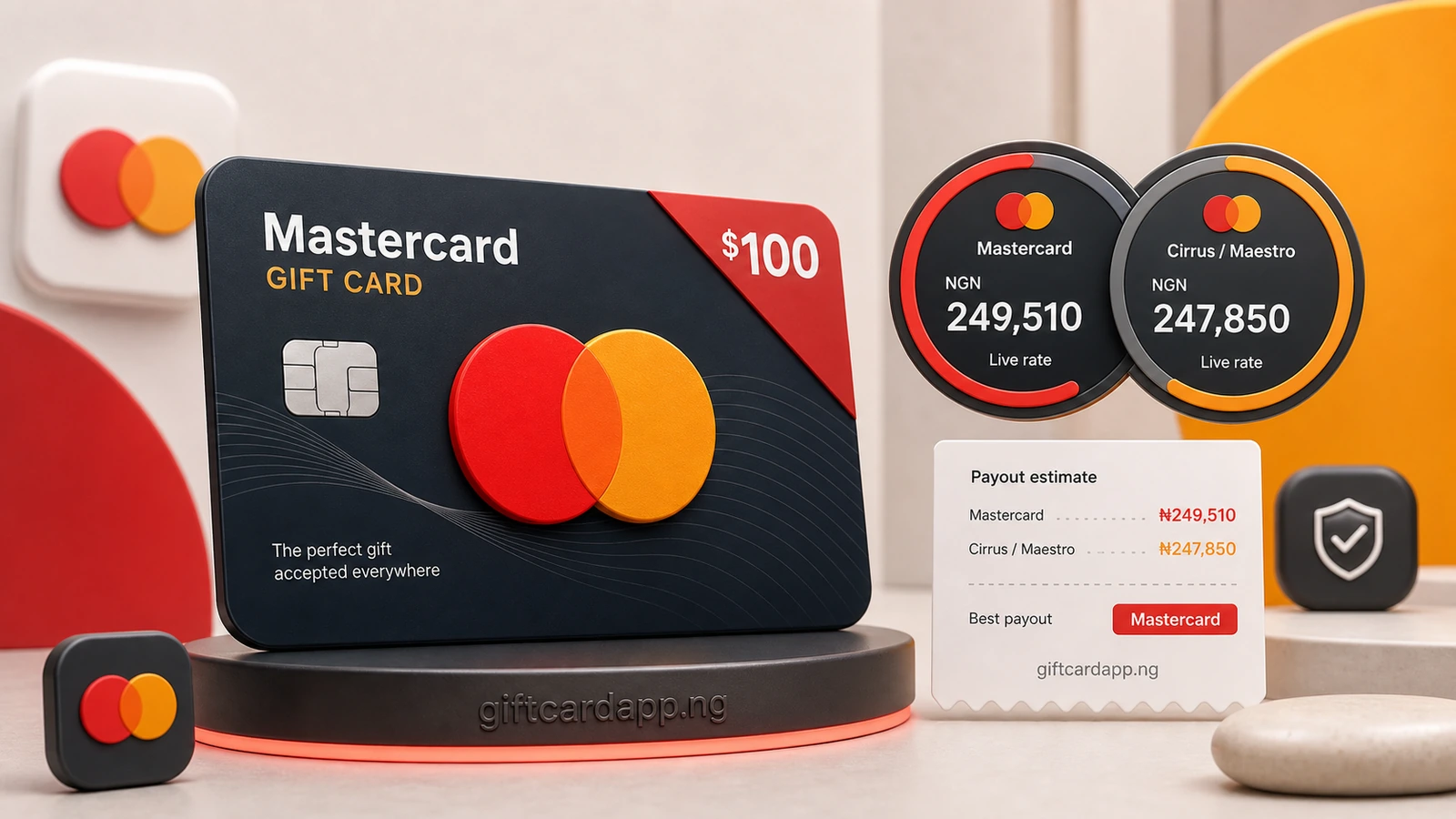
A Gift Card rate multiplier is the naira amount used for each unit of the card’s face-value currency when calculating an estimate. It is a pricing input for a specific card route, not a general foreign-exchange rate and not a guaranteed payout.
How the Gift Card multiplier calculation works
The basic calculation is:
Card face value × current route unit rate = estimated naira value
USD 100 × NGN 1,000 per USD 1 = NGN 100,000 estimated value.
The NGN 1,000 figure is chosen only to demonstrate the multiplication. It is not a live CardFlow rate or an offer.
If the same hypothetical unit rate applied to USD 50, the arithmetic would be USD 50 × NGN 1,000 = NGN 50,000. In practice, another denomination may have an amount-specific table value or a different current rule, so check the exact amount rather than assuming every card is linear.
For a full walkthrough of the inputs around one benchmark amount, read how a $100 Gift Card becomes a naira estimate. The separate guide to Gift Card denomination rate differences explains why one $100 card and several smaller codes with the same total are not always treated as the same item.
Use the card’s own currency
A USD route uses the dollar face value with a naira-per-dollar Gift Card unit rate. A GBP route uses the pound face value with the applicable naira-per-pound Gift Card unit rate. Do not convert a GBP, EUR, CAD or JPY card into dollars first unless the current pricing route explicitly uses that method.
Do not confuse the multiplier with the bank exchange rate
A Gift Card unit rate reflects the currently supported product route and its pricing conditions. It is not the official NGN foreign-exchange rate for cash, bank transfers or card payments. Comparing the two as though they were identical can produce a misleading expectation.
What determines which multiplier applies
The brand and printed value are not enough to identify the correct unit rate. A useful estimate request includes:
- Brand and product: for example, Apple Gift Card rather than “gift card.”
- Country or marketplace: a US product can follow a different route from a UK or Canadian product.
- Currency: USD, GBP, EUR, CAD, JPY or the exact currency shown.
- Format: physical card or eCode.
- Denomination: the value of each individual card or code.
- Current route: whether CardFlow currently has a supported pricing path for that exact product.
- Verification result: whether the submitted item matches the description and required evidence.
What proof can and cannot do
A matching receipt, order email or readable card photo may help confirm the claimed source and product details. Proof does not automatically create a premium multiplier or guarantee authenticity, unused balance, acceptance or payout. The applicable rate still depends on the exact current route and verified card.
Why two sellers can receive different estimates
Two people may both describe “Amazon $100,” while one has a US eCode and the other has a physical card from another marketplace. If the country, currency, format, denomination, evidence or timing differs, the selected route may also differ. That is a product comparison, not evidence that one seller was promised a secret universal rate.
Current Apple multiplier examples
These Apple US examples show how the active unit rate becomes several naira estimates. Exact denomination values are used where available instead of assuming every amount is simple multiplication. The output is dynamic and dated; it is not a guaranteed quote or payout.
Card value Rate per USD 1 Estimated naira value USD 25 NGN 872.26 NGN 21,806.50 USD 50 NGN 872.26 NGN 43,613.00 USD 100 NGN 872.26 NGN 87,226.00 USD 200 NGN 872.26 NGN 174,452.00
How to read a live multiplier responsibly
- Confirm that the displayed brand, country, currency and format match your card.
- Check the data date or current snapshot instead of relying on an old screenshot.
- Enter or select the exact denomination rather than copying another amount’s result.
- Read the estimate and any route note before exposing sensitive card details.
- Wait for the secure verification result before treating the amount as final.
The guide to Gift Card rate history versus live rates explains why an earlier multiplier is useful context but not a current promise. For broader post-quote changes, use the Gift Card rates in Nigeria guide.
Use multipliers to compare like-for-like estimates
A unit rate helps compare quotes only when the underlying card details match. Compare the same brand, country, currency, format, denomination and point in time. A large number attached to an incomplete product description is not more reliable than a smaller number with clear conditions.
Be cautious when someone advertises an unusually high multiplier but refuses to identify the route, pressures you to reveal a live code or promises acceptance before verification. Review the checklist for comparing Gift Card buyers in Nigeria without fake rates before sharing sensitive details.
Copyable quote request:
Brand: [brand]
Country/marketplace: [country or marketplace]
Currency: [currency]
Value: [individual denomination]
Format: [physical or eCode]
Proof available: [receipt, order email or other evidence]
Code status: protected and not shared
Common multiplier mistakes
- Using a USD unit rate for a GBP, EUR, CAD or JPY card.
- Applying one brand’s multiplier to another brand.
- Assuming physical cards and eCodes always share one route.
- Multiplying an old screenshot without checking the current data date.
- Treating five separate codes as one card with the combined value.
- Assuming a receipt guarantees a higher multiplier.
- Confusing an estimated naira value with settled payout.
Frequently asked questions
What does a Gift Card rate multiplier mean?
It is the naira unit rate used with a card’s face-value currency to calculate an estimate for a specific product route.
Is a Gift Card multiplier the same as the dollar-to-naira exchange rate?
No. A Gift Card multiplier is product-route pricing, not the general foreign-exchange rate for cash or bank transfers.
Can I use a dollar multiplier for a UK Gift Card?
Not unless the current route explicitly says so. A GBP card normally needs the applicable naira-per-pound Gift Card unit rate rather than a USD calculation.
Does a receipt guarantee a better multiplier?
No. A receipt can support verification of the source and product, but it does not guarantee a premium rate, acceptance or payout.
Why can the final amount differ from the multiplier estimate?
The submitted card may differ in country, currency, format, denomination, route or status from the assumptions used for the estimate. Current route data can also change.
 Why Gift Card Quotes Change Before Payout in NigeriaJun 23, 2026
 How Much Is a $100 US Gift Card in Naira?Jul 3, 2026
 Why Gift Card Denominations Can Have Different RatesJul 1, 2026