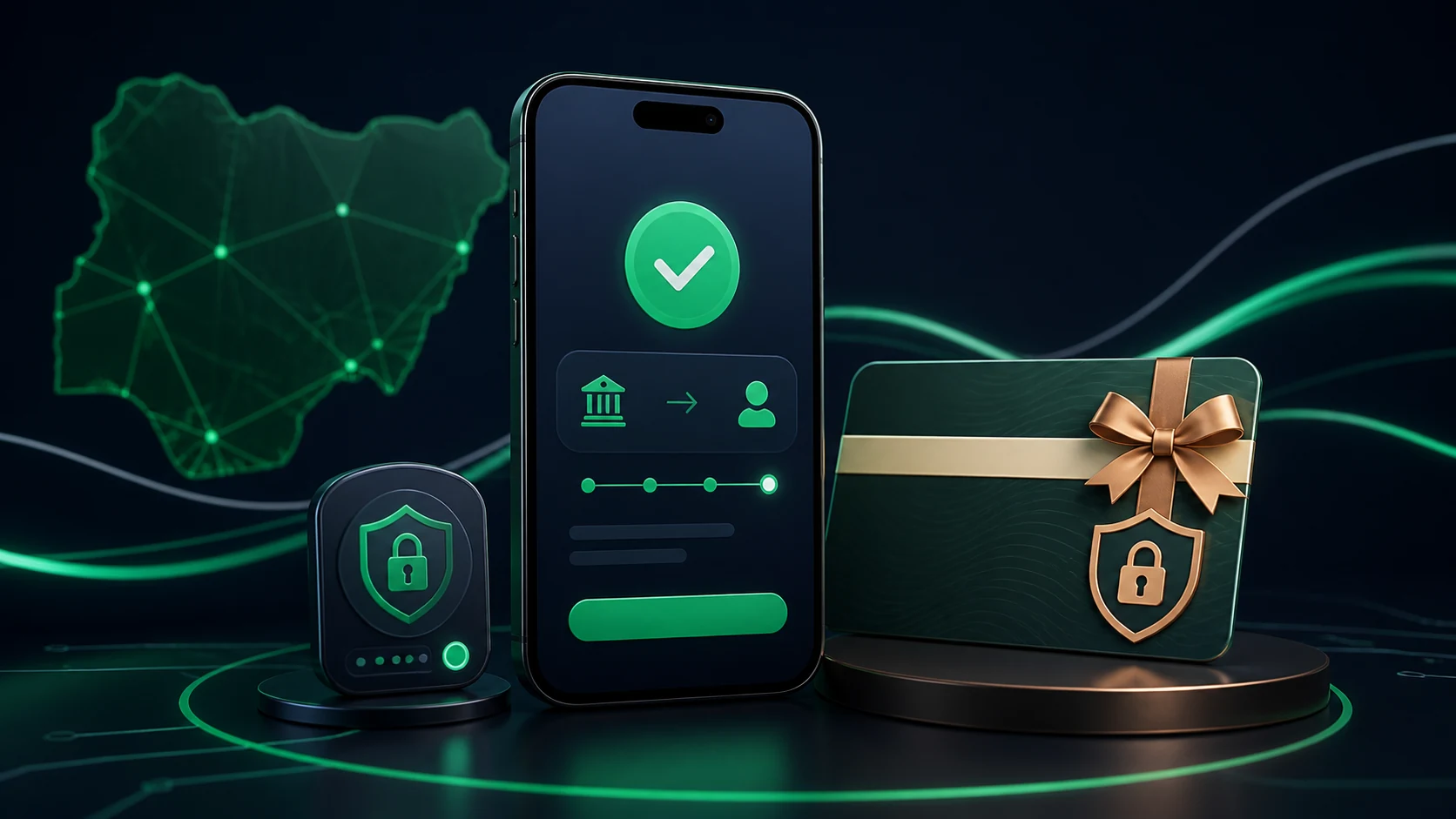
Policy update, checked August 5, 2026: Central Bank of Nigeria controls for instant payments took effect on July 1. They give customers more control over instant transfers and require stronger fraud monitoring by financial institutions. For a Nigerian Gift Card seller, the practical connection is the bank-transfer stage after a trade—not the card’s price or verification.
What changed on July 1, 2026?
CBN’s official summary says its March 2026 instant-payment guidance became effective on July 1. The measures are designed to curb electronic fraud and give customers more control. They apply at the banking and instant-payment layer, including the accounts and apps used to move money.
| CBN control | Official summary | Possible relevance after a Gift Card trade |
|---|---|---|
| Instant-transfer switch | A customer can voluntarily disable instant transfers for a chosen period while still being able to transact at a branch. | An account setting may explain why an expected instant transfer cannot proceed normally. Confirm the setting with the bank; do not guess. |
| Personal limits | Banks must allow customers to request lower transaction limits, subject to verification and risk assessment. | A customer-selected limit can affect transfer capacity. It is separate from any Gift Card platform quote. |
| One mobile device | A mobile-banking app may be linked to only one device at a time. | Changing phones can require reactivation before normal app use resumes. |
| New-device control | A newly activated device carries a temporary NGN 20,000 transaction limit for its first 24 hours. | A recent device change may affect app-initiated transfers during that window. It is not a NGN 20,000 cap on Gift Card sales or every incoming credit. |
| Fraud monitoring | Financial institutions must deploy real-time enterprise fraud monitoring and strengthen identity checks for online onboarding and reactivation. | A bank may perform a security check. Only the institution can explain a specific review or hold. |
The policy sits within a wider direction. CBN launched Payments System Vision 2028 on June 1, 2026 around interoperability, security, inclusion, innovation, trust and collaboration. Its stated objectives include stronger supervision and consumer protection.
What this means for a Nigerian Gift Card seller
Most Gift Card sellers encounter the payments system at the final stage: an approved trade is paid to a bank account or wallet. The new rules make four checks more important before relying on an instant-transfer expectation.
- Confirm the receiving account. Recheck the account name, bank and number before requesting a payout. A policy update does not correct wrong bank details.
- Consider recent device changes. If you activated your banking app on a different phone less than 24 hours ago, check the bank’s official guidance before assuming an app or trader caused a limit.
- Know your own settings. If instant transfers are disabled or you requested a lower personal limit, the account may not behave like another customer’s account.
- Keep one transaction record. Save the trade ID, quoted amount, payment status and bank-transfer reference. These are more useful in a genuine enquiry than a cropped credit-alert screenshot.
A platform should distinguish between trade approved, payout initiated and funds received. Those are different events. A transfer reference can support tracing, but it is not the same thing as a cleared balance in your account.
What the CBN rules do not change
The instant-payment guidance is not a Gift Card pricing rule. It does not determine whether an Apple, Steam, Amazon, Google Play or other card is authentic, unused, supported or acceptable. It also does not decide the naira value of a card.
- It does not create a fixed Gift Card exchange rate.
- It does not guarantee that a card will pass verification.
- It does not promise an instant platform review or bank credit.
- It does not prove that a payment-alert screenshot is genuine.
- It does not authorise a trader to collect your OTP, banking password or card PIN.
For a current estimate, use CardFlow’s Gift Card rate page and match the exact brand, country, currency, denomination and format. Treat the result as a dated estimate rather than a promised final amount.
If a Gift Card payout appears delayed
Do not immediately conclude that a fraud rule blocked the money. A delay can have different causes, and only the relevant platform, sending institution and receiving bank can confirm the status of a specific transfer.
- Open your transaction history and confirm whether the trade is still under review, approved, paid or failed.
- Verify that the saved receiving account belongs to you and contains no number or bank mismatch.
- Check your actual account balance or official bank statement, not only an SMS, email or screenshot.
- Record the amount, time and transfer reference without posting sensitive information publicly.
- Contact the platform through its official support channel, then contact your bank if the transfer reference requires tracing.
How to judge a platform under stronger payment controls
Regulation of banks does not automatically make every Gift Card buyer trustworthy. Before submitting a redeemable code, compare the entire transaction process rather than a headline rate.
| Check | Transparent practice | Warning sign |
|---|---|---|
| Quote | The exact card route and estimated payout are shown before submission. | A high rate is promised without identifying region, format or conditions. |
| Status | The platform separates review, approval and payout stages. | Support claims “paid” but refuses to provide a traceable transaction record. |
| Bank details | You can verify the receiving account before requesting withdrawal. | An agent asks to log in to your bank or change details over an unofficial chat. |
| Security | Sensitive Gift Card details stay inside the protected submission flow. | You are asked to send the full code, banking OTP or password in a message. |
| Problem resolution | Official support records the trade ID and explains the next check. | You are pressured to pay another fee or make a second transfer. |
Use the Gift Card buyer comparison checklist before choosing a route, and review CardFlow account security tips before uploading card evidence or changing payout details.
Why the policy matters without being a rate signal
Secure payment rails matter to the usefulness of any Gift Card quote. If the account, device or transfer path is not ready, a good-looking estimate does not produce a completed payout. That is why sellers should consider payout transparency and account security alongside the current card estimate.
But the policy should not be turned into market hype. CBN did not say the July 1 controls would raise Gift Card prices or make every payout faster. The direct policy story is consumer control and fraud reduction within instant payments. The resale value of a specific card still depends on the card route, market demand, region, denomination, format, available capacity and successful verification.
For related policy context, the July 31 CardFlow daily brief explains Nigeria’s separate PoS geo-fencing timetable. That PoS story and this instant-payment update concern different controls; neither creates a Gift Card rate.
CBN instant-payment rules and Gift Card payout FAQs
Did CBN place a NGN 20,000 limit on every Gift Card payout?
No. The temporary NGN 20,000 control described by CBN applies to mobile-banking apps newly activated on a device for their first 24 hours. It is not a universal Gift Card trade limit.
Can CBN’s new instant-payment rules change Gift Card rates?
The rules govern instant-payment controls and fraud safeguards; they do not set Gift Card exchange rates, route availability or final quotes.
What should I do if a Gift Card payout does not arrive?
Check the transaction status and receiving-account details, save the reference, and contact the platform and your bank through official channels. Do not pay a release fee or share an OTP.
Should I split a payout to avoid a bank limit?
No. Do not structure transfers to bypass a limit or fraud control. Ask the bank or payment provider which legitimate option applies to your account.
Can a Gift Card platform ask for my banking OTP or password?
No. Never give a platform or support agent your banking password, card PIN or one-time password, and do not allow remote access to your device.
CBN documents behind this update
These links support the policy dates and controls in this article. Check the CBN site for later amendments.
- CBN Reforms and InitiativesOfficial summary of the instant-payment controls and July 1, 2026 effective date.
- CBN: Additional Functionalities for Instant PaymentOfficial circular listed by CBN in March 2026.
- Nigeria Payments System Vision 2028Official payment-system principles and consumer-protection direction launched June 1, 2026.
Fact-checked by the CardFlow Editorial Team on August 5, 2026. Payment rules and bank implementation details can change; confirm account-specific limits and transfer status with your financial institution.
 How to Sell Gift Cards for Cash in Nigeria (2026 Guide)Jun 12, 2026
 Why Gift Card Quotes Change Before Payout in NigeriaJun 23, 2026